Tattoos and body markings can mean all manner of different things to different people.
What is celebrated in one part of the world can be viewed as inappropriate
somewhere else; a sigil or illustration that has significant meaning in one place might look like random squiggles in another.
I think it’s safe to assume that human beings have been expressing themselves
and promoting messages through their appearances for about as long as we’ve been around as a species.
Unless you live on a remote island somewhere, you’ll be used to seeing people sporting tattoos.
Some might be trivial designs they regret getting when their were young,
but others can have deep, impactful connotations, those that tell stories or adhere to customs or traditions…
I don’t know about you, but I find it particularly interesting when I see the same tattoo
on a number of different people. That is to say I’m instantly intrigued as to what the tattoo
in question means, and just why the person in question thought it was so important
that they wanted to wear it as a visible marker for the rest of their lives.
One that I’ve seen a good many times over the years – and, until now, never thought to research,
I might add – is that of the so-called ‘red string of fate’.
It’s highly likely that some of our readers will recognize the small, red tattoo, but there’s every chance that its symbolic meaning is not known to many of those who have seen it before.
As I said, I’d seen the tattoo on a number of people. Enough, certainly, to notice a pattern. This mark had to mean something, I just had no idea what.

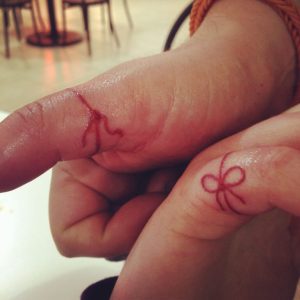
So I did a little digging – thanks, internet – and found that the red string tattoo in question is known in Asian cultures as the ‘red string of fate’. Most commonly appearing on the thumb of a man and the pinky finger of a woman, the tattoo looks like a simple bow with tails, not unlike a tied shoelace.
It turns out there’s a symbolic meaning behind this small tattoo, and one that has its roots in romance and hope. The story reportedly comes from the Chinese tale of a matchmaker who knows the person each of us is fated to be together with.
Of course, the idea of being destined or fated to meet someone else isn’t reserved exclusively for romantic endeavors, just as the concept of being connected to someone else via an invisible bond isn’t confined to just one culture, but rather present in virtually all.
In this instance, the red string of fate implies that two people are destined lovers, irrespective of place, time, or circumstances. For some, that’s a warming, comforting thought. Others, however, would surely prefer to be wholly in charge of their own destiny.
What camp do you sit in? And have you ever seen someone wearing the red string of fate tattoo?