Puzzles have been popular among intellectuals for a long time now. They come in various levels of difficulty, some taking seconds to solve and others taking months. Some puzzles have not even been solved to this day.
No One Can Figure This Out, Will You Be The First?
People have different opinions about puzzles – some dislike them, while others love them. But regardless of your preference, solving puzzles is great for exercising and sharpening the mind. It teaches the brain to approach situations from different angles in order to find a solution to any given problem.
There is one particular puzzle that has been circulating on the internet and leaving people puzzled. At first glance, it doesn’t seem like a puzzle at all. It’s a picture of numbers from 1 to 15 arranged next to each other, with text below asking the audience to repost when they find the error. That’s what you’ll see at first glance.
You might go through the whole thing again, but find no error. The numbers are perfect from one to fifteen – no missing numbers or numbers written incorrectly. You might go through them again, one by one, searching for a pattern or sequencing, but you’ll find nothing. They are all perfectly arranged.
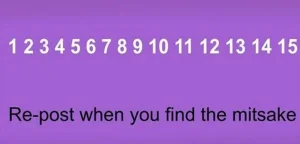
At this point, you might start thinking outside the box. What if the error lies in the absence of zero? Or maybe the number sixteen should have been included. Or is it the spacing? The spacing is perfect. Is that an I or a 1? They are all ones. That 6 has an odd shape. No, it’s perfect. So what is the error?
It’s likely that you’ll take a closer look at the sentence rather than the numbers and realize that you’re being asked to find the ‘mitsake’ and not the error. Well, there’s the mistake!
The MISTAKE is that in the picture, the word “mistake” is spelled as “mitsake”. But most people are unable to spot it because they are focused on the numbers.
It’s almost amazing how much time you spent looking for the ‘mitsake’ in the numbers without even giving the instructions a glance. Nevertheless, it’s a great puzzle. This one teaches us to look at the bigger picture to find the solution to any problem. Whoever created this puzzle must have known that many people wouldn’t solve it that easily.
Solving puzzles has a surprising number of benefits. For one, researchers have observed that they are great for improving memory, particularly short-term memory. Puzzles challenge us to think quickly and act fast, which in turn enhances the speed of mental processes and improves the connections between brain cells.
Puzzles also equip us with excellent analytical skills. They require a logical level of critical thinking and creativity to solve. Take this puzzle for example – it requires us to analyze the whole image and realize that the trap is in the question, not the numbers. This skill can be applied to everyday life to solve problems that don’t have obvious solutions.
It is a highly valued skill in the workforce and puts individuals ahead of others in areas such as leadership and management. Therefore, it’s important to cultivate the habit of solving puzzles in order to enhance ourselves with such skills.