Have you ever found yourself so bored that you turned to a challenging math problem for entertainment?
Well, here’s a brain-teaser that has been making rounds on social media every few years, stumping both kids and adults alike.
This isn’t just any math problem; it’s one that has sparked global debates about the right way to solve it.
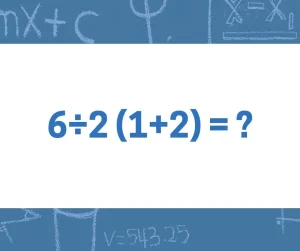
The problem in question is the seemingly simple equation: 6÷2(1+2). Despite its straightforward appearance, it has led to a variety of answers, causing confusion and debate.
SOURCE:CANVA
The YouTube channel MindYourDecision sheds light on this by explaining, “I explain how to get the correct answer by using the modern interpretation of the order of operations.
I also explain how you would get a different answer under historical usage of the division symbol.”
To tackle this problem, we need to revisit the PEMDAS rule, which stands for Parentheses, Exponents, Multiplication/Division, and Addition/Subtraction.
Remember, when operations have the same precedence, we solve them from left to right.
So, how do we solve 6÷2(1+2)? The answer is 9, and here’s why.
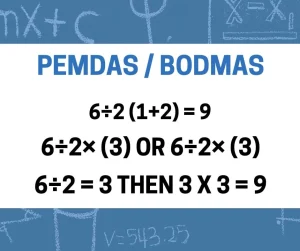
Keeping PEMDAS in mind, we first solve the equation inside the parentheses: 1 + 2 = 3.
This changes our equation to 6÷2×3.
Since multiplication and division are of the same priority in PEMDAS, we solve from left to right.
First, we do 6÷2 = 3, and then 3 x 3 = 9.
Voilà! The answer is 9.
SOURCE:CANVA
Interestingly, MindYourDecisions also explored an older method from a 1917 textbook.
In this approach, after solving the parentheses, you would multiply 2 and 3 first, resulting in 6÷6 = 1.
However, this method is outdated, and the correct modern interpretation gives us 9 as the answer.
This math problem isn’t just a way to pass time; it’s a brain exercise that enhances strategic solving skills.
It’s a fun and engaging way to challenge yourself and others.
Did you figure out the correct answer on your first try?
It’s a great example of how math can be both fun and perplexing.
If you enjoyed unraveling this math mystery, why not share it with friends and family? It’s a great way to engage others in a bit of intellectual fun.